 new in 1.1.0: her room
 try on whole outfits, free
 anonymous letters to strangers who write like you
 strangers send you stickers
 a tarot card after ten letters
 no profiles. no photos. no swiping.
 free on iPhone
Deep conversations with strangers: why they feel better than small talk, where to have one online, and how to start
What twelve experiments found about talking to strangers beyond small talk, the kind of place online where that works, and five steps for the first message.
the short version
Deep conversations with strangers usually go better than people expect. In twelve experiments with more than 1,800 people, strangers cared more about each other's honest answers than either side predicted, and pairs felt closer after deep talk than small talk; online, the nearest thing is writing to someone who doesn't know you, with one true detail and one real question.
6 sourcesKindredly is an anonymous penpal app that matches strangers by how they write.
You sit next to someone for an hour and talk about the weather, the traffic and how often they come here. Afterwards you know nothing about them, and they know nothing about you. You wanted to ask something real and didn't, because you assumed they wouldn't want to answer.
That assumption is usually wrong. In a 2021 series of twelve experiments with more than 1,800 people, researchers from the University of Chicago, the University of Texas at Austin and Northwestern University found that conversations between strangers went better than people expected, and that the gap was biggest for deep conversations. People thought a stranger wouldn't care about their honest answers. The stranger cared more than they guessed. Online, you can get the same thing by writing to someone who doesn't know you, with one true detail and one real question.
Why deep conversations with strangers feel better than small talk
The study, published in the Journal of Personality and Social Psychology by Michael Kardas, Amit Kumar and Nicholas Epley, paired people who had never met. Some got shallow questions, like these from one of the experiments:
- How is your day going so far?
- What do you think about the weather today?
- How often do you come here?
Others got deep ones, like these from another, adapted from the "fast friends" questions that psychologist Arthur Aron and his colleagues published in 1997:
- For what in your life do you feel most grateful?
- If a crystal ball could tell you the truth about yourself, your life, your future, or anything else, what would you want to know?
- Can you describe a time you cried in front of another person?
Before talking, people predicted how the conversation would go. Afterwards, they said how it went. Across the experiments, the paper reports, the talks went better than people had guessed: they were less awkward, and people felt closer and happier afterwards, than they had expected. People overestimated the awkwardness of deep talk more than that of small talk. In two experiments where each person had one deep and one shallow conversation, they felt more connected to the partner from the deep one.
The reason, according to the authors, is a wrong guess about the other person. People expected a stranger to care less about what they shared than the stranger actually did. With close friends and family, whose interest they already knew, their predictions were closer to what happened. As UT News put it in its report on the study, people "consistently underestimated how interested their partners would be".
Two more details are worth holding on to. In one experiment, participants said they wished they had more deep conversations with strangers than they usually do, and that wish was stronger than any wish for more small talk. And in one experiment, most of the groups met over Zoom instead of in a room.
Small talk isn't useless. The same research found that shallow conversations also went better than expected. It just leaves you knowing less, and the people in these studies wanted to know more.
Where to have a deep conversation with a stranger online
The studies above were about talking, not writing, so treat what follows as a reasonable step from the research rather than something it measured.
The barrier the researchers found is a fear that the other person won't care. Online, some places make that fear bigger and some make it smaller. Here is what tends to help:
- A place where depth is the point. In the experiments, both people knew they were there to answer deep questions. Online, the nearest thing is a place built for honest writing, not for quick replies: letter-based pen pal apps, anonymous letter apps, and small forums where long posts are normal.
- Writing, not live chat or video. A letter gives you time to say the true thing well, and the other person time to answer it. Nobody is waiting for you to fill a silence.
- No profile to judge first. If the first thing a stranger sees is your face, your age and your city, the conversation starts with those. If the first thing they see is what you wrote, it starts there.
- A small number of people at once. One stranger who answers carefully is closer to the experiments than a crowd of comments.
Writing to someone who does not know you has its own research behind it, which our guide on why writing to a stranger lowers your stress goes through. And before you share anything, read how to write to strangers safely: the point of a deep conversation is your thoughts, never your address, your workplace or your bank details.
How to start a deep conversation with a stranger
Michael Kardas, the study's lead author, is quoted by PsyPost saying that reaching out is one of the most important steps. The rest is easier than it sounds.
- Go one step deeper than you planned. You don't have to open with the last time you cried. The Greater Good Science Center at UC Berkeley, writing about the study, suggests asking gradually more intimate questions.
- Share first. Give one specific, true detail about yourself before you ask anything. "I moved here in March and still don't know where to buy good bread" is easier to answer than "Tell me about yourself."
- Ask one real question, not five. Borrow from the study: what are you most grateful for, or, if a crystal ball could tell you one true thing about your life, what would you want to know.
- Assume they care more than you think. That is the whole finding. If you are about to delete the honest sentence because they won't be interested, leave it in.
- Answer their question as well as they answered yours. Depth goes both ways, or it stops.
If you are stuck on the first line, our guide to the first letter to a penpal has openings you can use, and questions to ask a penpal has more questions sorted from light to deep.
What the research doesn't tell you
The authors list the limits themselves. In every experiment, both people knew they were in a study and had been told what to talk about. A deep question from a stranger in a supermarket queue, they write, might be received quite differently. They also note that a stranger could read too much into a personal question, for example as romantic interest or as an attempt to take advantage, and that people starting a conversation may not see that coming.
The experiments measured single conversations, not friendships over months. According to the Greater Good Science Center, most of them were run in the United States. And none of this is a treatment for anything: for that, talk to a professional.
The authors' own reading of the limits is hopeful: they think people may underestimate deep conversations even more outside the lab, where they also underestimate how willing strangers are to talk at all. They point to earlier research by Epley and Schroeder showing exactly that on trains, buses and in cabs.
Trying it on Kindredly
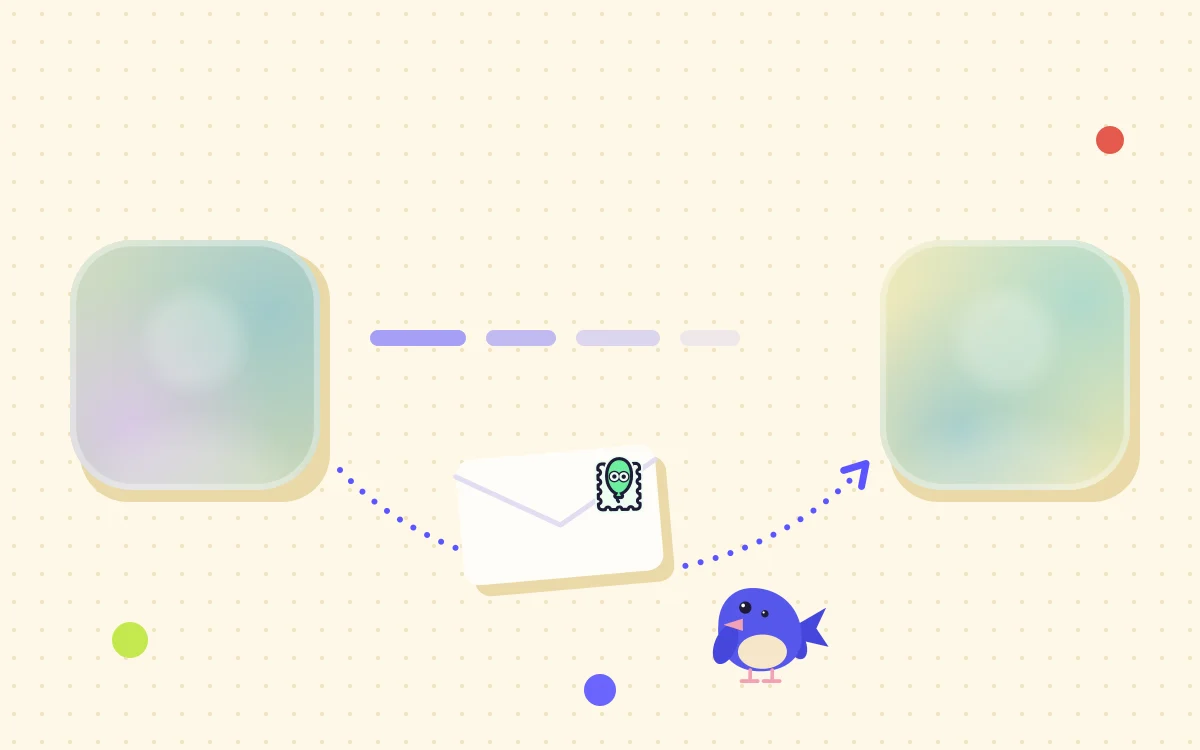
Kindredly is one place built for this. You write a letter to nobody in particular, and it lands first on the desks of strangers who write the way you do, matched by the rhythm and shape of your writing, not by photos, profiles or location. When one of them writes back, you have a penpal, and you trade letters one at a time.

A stranger sees a name the app gives you, never your own, and no face: a frosted window where a face would be, your letters, and your star sign unless you turn it off. There is no profile. A safety check reads letters before they go out to strangers' desks, anyone can be reported or blocked in one tap, and it is for adults only, 18 and over. After five letters each way, either of you can enclose your name, and names are revealed only when both of you have.
It is free to write, on iPhone and the web. If you would rather see what strangers write before you write anything, read today's letters without an account. One of them may be the conversation you meant to start.
Questions people ask
Do people actually enjoy deep conversations with strangers?
Mostly, yes, and more than they expect. In twelve experiments with more than 1,800 participants, published in 2021 in the Journal of Personality and Social Psychology, Michael Kardas, Amit Kumar and Nicholas Epley found that conversations between strangers felt less awkward and more connecting than people predicted. The gap was largest for deep conversations, and people who had both kinds felt more connected to their deep conversation partner.
Why do we avoid deep conversations with strangers?
Because we think the other person won't care. The same 2021 study found that people expected strangers to be less interested in their honest answers than the strangers actually were. With close friends and family, whose interest they already knew, people predicted more accurately. Knowing that strangers usually care more than you think is the first step.
How do you have a deep conversation with a stranger online?
Pick a place where long, honest writing is normal and nobody judges a profile first, such as a letter-based pen pal app. Share one specific true detail, then ask one real question, for example what the other person is grateful for at the moment. The Greater Good Science Center at UC Berkeley suggests making each question a little more personal than the last rather than starting with the deepest one. Never share your address, workplace or money details.
What is a good deep question to ask a stranger?
The 2021 study by Kardas, Kumar and Epley used questions adapted from Arthur Aron's 1997 "fast friends" set, such as "For what in your life do you feel most grateful?" and "If a crystal ball could tell you the truth about yourself, your life, your future, or anything else, what would you want to know?" Questions like these invite a story rather than a fact. Start with one, and answer it yourself as well.
Sources
- American Psychological Association, Journal of Personality and Social Psychology: Overly Shallow?: Miscalibrated Expectations Create a Barrier to Deeper Conversation (Kardas, Kumar and Epley, 2021)
- The University of Texas at Austin, UT News: Swapping Small Talk with Strangers for Deeper Dialogue Offers Surprising Rewards
- Chicago Booth Review: Deep Conversations with Strangers Are More Fulfilling than Small Talk
- Greater Good Science Center, UC Berkeley: We Want to Have Deeper Conversations With Strangers. Why Don't We?
- ScienceDaily (American Psychological Association release): Getting beyond small talk: Study finds people enjoy deep conversations with strangers
- PsyPost: New psychology research finds deep conversations with strangers tend to go better than people expect
pick one. i'll wait. (i'm a bird. i'm good at waiting.)
free · no profile · no photos of you
what you type stays on this device